
Google Ads Circumventing Systems Suspension: What It Means and How to Appeal
By IKhlaq, Black Ads Agency · Reviewed by Umar, Founder · Updated 17 October 2026
Key takeaways
- “Circumventing systems” is one of Google’s egregious policies: accounts are suspended on detection, without a prior warning.
- The policy covers cloaking, creating new accounts after a suspension, re-submitting disapproved ads in disguise and false verification details.
- Google reinstates accounts “only in compelling circumstances”, so an appeal must show the cause has been removed completely.
- Submit one appeal at a time and never open new accounts while the appeal is pending.
Few Google Ads messages are as alarming as “Your account has been suspended due to Circumventing systems policy violations”. Every campaign stops, the suspension can spread to linked accounts, and Google states that suspended advertisers will not be allowed to advertise again unless an appeal succeeds. Some of these suspensions are mistakes, triggered by a hacked website, a misconfigured redirect or an account linked to someone else’s history. Others reflect real violations such as cloaking.
This guide explains what Google means by circumventing systems, the behaviour that triggers it, how to tell if your suspension could be an error, and how to prepare an appeal with the best realistic chance of success. It is based on Google’s official Circumventing systems policy and appeal process, and on the suspended accounts our team reviews for advertisers in the US, UK, Canada and Australia.
Table of Contents
- What Is the Circumventing Systems Policy?
- What Triggers a Circumventing Systems Suspension
- How Google Defines Cloaking
- Could Your Suspension Be a Mistake?
- How to Appeal a Circumventing Systems Suspension
- What to Include in the Appeal
- How Long Does an Appeal Take?
- What If the Appeal Is Rejected?
- Country Requirements: US, UK, Canada and Australia
- How to Avoid a Circumventing Systems Suspension
- When to Get Professional Help
- Circumventing Systems FAQs
- Final Takeaway
What Is the Circumventing Systems Policy?
Google Ads doesn’t allow advertisers to trick or get around its ad review processes with their ads, content or destinations. Google classes this as an egregious violation, the same group as counterfeit goods and malicious software. That has three practical consequences:
- No warning: the account is suspended as soon as the violation is detected.
- Wide review: Google may look at your ads, website, other accounts and third-party sources, not just the ad that triggered the alert.
- High bar for appeals: accounts are reinstated only in compelling circumstances, so vague or incomplete appeals are usually rejected.
What Triggers a Circumventing Systems Suspension
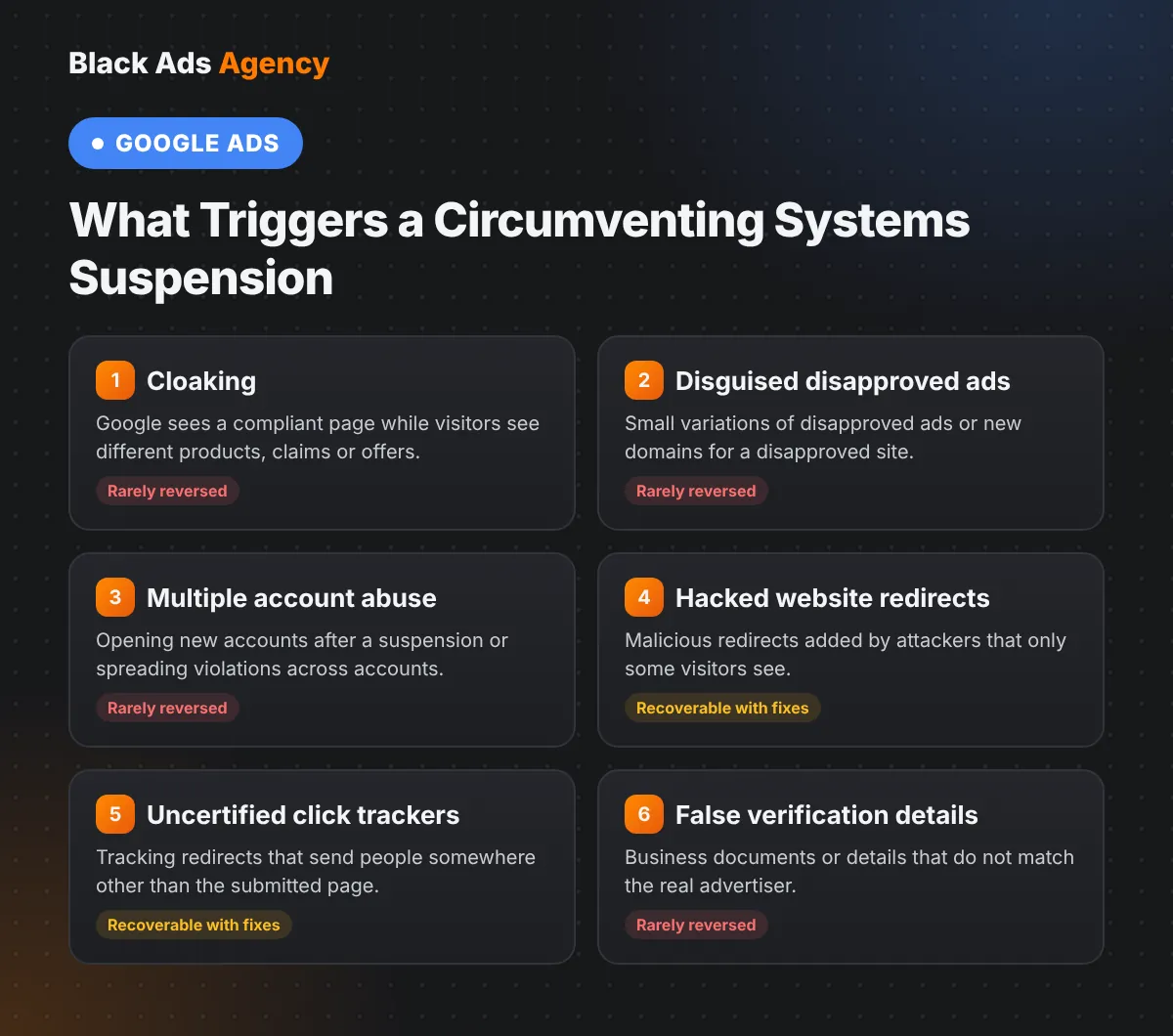
Google lists several behaviours under this policy. These are the ones we see most often in suspended accounts:
| Behaviour | What it looks like in practice |
|---|---|
| Cloaking | Google’s crawler sees a compliant landing page while visitors see different products, claims or offers |
| Recreating disapproved content | Small variations of a disapproved ad, new domains for a disapproved site, or text and images designed to hide prohibited content |
| Multiple account abuse | Opening new accounts after a suspension, or spreading violating ads across several accounts |
| Missing certifications | Using several accounts to promote gambling, financial or healthcare products without the required Google certification |
| False verification details | Submitting documents or business information that don’t match the real advertiser |
| Feature abuse | Using redirects, click trackers or other product features to send users to non-compliant content |
Google also notes that ordinary editorial disapprovals, such as formatting or spelling problems, don’t lead to suspensions under this policy.
How Google Defines Cloaking
According to Google, cloaking means showing different content to Google than to people in order to hide things that might break Google Ads policies. Examples in the policy include showing Google a compliant destination while visitors see something else, an intrusive pop-up that stops Google from reaching the landing page, and click trackers that redirect people to prohibited content.
Not every difference counts as cloaking. Google explicitly allows showing a page in different languages, different special offers, adjustments for location or slower connections, and certified click trackers, as long as the promoted product or service is the same for everyone. That distinction matters in an appeal: if your site personalises content for legitimate reasons, explain it clearly.
Cloaking also appears without the advertiser’s knowledge. Hacked WordPress sites often have malicious redirects that only show to some visitors, which Google’s systems read as cloaking. If you didn’t set up any redirects, scan your site before you appeal.
Could Your Suspension Be a Mistake?
Before you write the appeal, work through these checks. Each one has caused suspensions in accounts we have reviewed:
- Hacked website: run Google’s Safe Browsing site status check, review your plugins and server files, and look for redirects you didn’t create.
- Tracking redirects: check that every click tracker and URL shortener is certified by Google and lands on the same page you submitted.
- Linked accounts: a payment method, admin email, domain or device shared with a previously suspended account can link you to its history.
- Geo or device rules: server rules that block Google’s crawlers, certain countries or certain devices can look like cloaking.
- Agency or freelancer setup: if someone else managed the account, ask exactly what they configured on the website and in tracking.
How to Appeal a Circumventing Systems Suspension
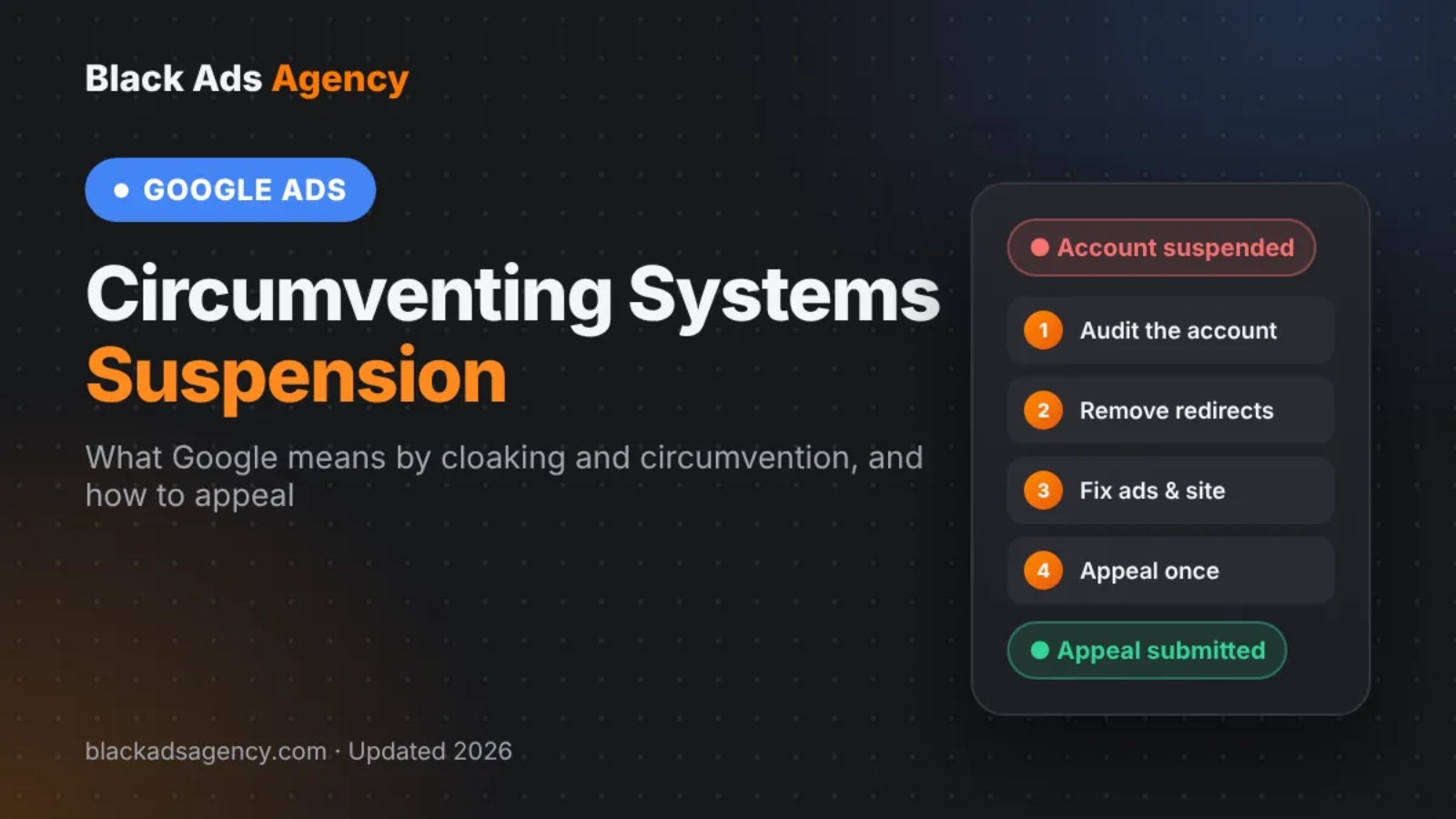
- Read the suspension email and the policy page in full, and list every ad, asset and website in the account, including paused ones.
- Remove anything that could show different content to Google and users: redirects, cloaking scripts, uncertified click trackers and blocking rules.
- Fix or delete every disapproved ad, and make sure each landing page clearly shows the same product, your business details and legal pages.
- Check that all verification details match your legal business documents, and obtain any certification your product category needs.
- Open the “Contact us” link in the suspension notice and complete the appeal form with an honest, specific explanation and the changes you made.
- Submit only one appeal and wait for the email decision; do not create new accounts or run the same ads elsewhere while it is pending.
Google notes that sending repeated appeals while one is pending can lead it to stop processing certain appeals for 7 days.
What to Include in the Appeal
Google advises advertisers to be “thorough, accurate, and honest”. A strong appeal for this policy usually contains:
| Section | What to write |
|---|---|
| Who you are | Legal business name, website, country and what you sell |
| What happened | Your best explanation of the cause, for example a hacked plugin, an uncertified tracker or a former agency’s setup |
| What you changed | Specific actions: redirects removed, malware cleaned, tracker replaced, ads deleted, verification updated |
| Evidence | Security scan results, hosting support tickets, screenshots or invoices that support your explanation |
| Prevention | How you will stop it happening again, such as security monitoring, change approval or certified tools only |
If your account really did use cloaking, say so plainly and confirm it has been removed. Denying a violation that Google has evidence for is one of the most common reasons appeals fail.
How Long Does an Appeal Take?
Google reviews the appeal and the whole account, then sends the decision by email. Simple cases can be decided within a few business days; complex ones can take longer. While the appeal is pending, the account shows an “Appeal pending” status.
What If the Appeal Is Rejected?
A rejected appeal usually means the suspension stands. You may appeal again only if you have genuinely new information, such as proof of a hack you didn’t know about. Opening new accounts to keep advertising counts as multiple account abuse, and Google states it will suspend those accounts too. If Google Search ads are no longer an option, focus on channels where your product is eligible and build organic traffic that doesn’t depend on ad approval.
Country Requirements: US, UK, Canada and Australia
Some suspensions start with products that need certification in the target country. Google’s financial products and services policy is a good example:
- United Kingdom: financial services advertisers must be authorised by the FCA and verified by Google.
- Canada: crypto exchanges need FINTRAC registration before targeting Canadian users.
- Australia: crypto exchanges need AUSTRAC registration; health product ads must follow the TGA Advertising Code.
- United States: regulated products need the relevant federal or state licences, and claims must meet FTC truth-in-advertising rules.
Spreading such ads across several accounts to avoid certification is one of the behaviours listed under circumventing systems.
How to Avoid a Circumventing Systems Suspension
- Show Google and users the same product, page and offer every time.
- Use only Google-certified click trackers and keep redirects simple.
- Keep your website secure and monitor it for unexpected redirects.
- Fix disapproved ads instead of re-uploading variations of them.
- Get the certifications your product needs in each target country.
- Use one account per real business, with accurate verification details.
For everyday disapprovals, our guide to Google Ads disapproved: common reasons and fixes explains how to resolve them before they turn into a suspension.
When to Get Professional Help
Circumventing systems appeals are hard to win and you rarely get several attempts. Black Ads Agency audits the account, website, tracking and verification details to find the most likely trigger, removes the issues and helps you prepare an honest, well-documented appeal. We also help advertisers plan compliant campaigns for each target market through our Google Ads approval service. Contact our team to discuss your account.
Circumventing Systems FAQs
What does circumventing systems mean in Google Ads?
It means trying to trick or get around Google’s ad review, for example through cloaking, recreating disapproved ads, opening new accounts after a suspension or submitting false verification details.
Can a circumventing systems suspension be lifted?
Yes, but only in compelling circumstances. Appeals succeed most often when the cause was a hacked website, an uncertified tracker or another genuine mistake that has been fully fixed.
Is cloaking always a violation?
Cloaking that hides policy-breaking content from Google is always a violation. Showing different languages, offers or location-based versions of the same product is allowed.
Will a new Google Ads account work after a suspension?
No. Creating accounts to re-enter Google Ads after a suspension is itself a circumventing systems violation, and those accounts are usually suspended as well.
How many times can I appeal?
Submit one appeal at a time. Google may stop processing appeals for 7 days if it sees repeated submissions while one is pending.
Can a hacked website cause a circumventing systems suspension?
Yes. Malicious redirects added by attackers can look like cloaking. Clean the site, document the fix and explain it in your appeal.
Final Takeaway
A circumventing systems suspension is one of the most serious outcomes in Google Ads, but it is not always the end. Understand exactly what Google considers cloaking and circumvention, remove every possible trigger, and submit one honest, evidence-backed appeal. If you need help reviewing your account or preparing compliant campaigns for the US, UK, Canada or Australia, Black Ads Agency can guide you through it.
Last updated: October 2026
Related ad approval services: Facebook ads cloaking agency · Google Ads cloaking agency · TikTok ads cloaking agency · Snapchat ads cloaking agency · Pinterest cloaking agency · YouTube ads approval

About the Author
Black Ads AgencyBlack Ads Agency is a digital advertising agency helping businesses navigate restricted and high-risk advertising categories. The Black Ads Agency team focuses on paid campaign strategy, creative development, landing page optimization, account-recovery support, and helping advertisers understand advertising platform policies.
Our services cover Google, Meta, TikTok, YouTube, Pinterest, and Snapchat advertising, with a focus on clearer campaigns, better landing pages, and reduced avoidable advertising risks.